
Planning a UAE company? Book a short online meeting to talk through your options.
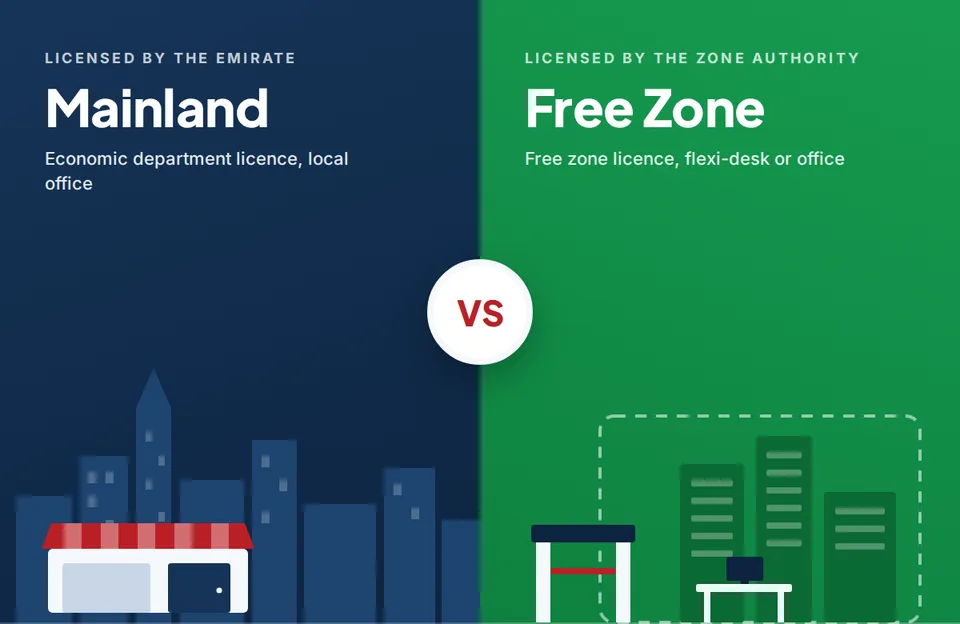
Book a consultationChoosing between a mainland and a free zone company is the first big decision in a UAE setup. Both can be 100% foreign-owned in most cases; the real differences are where you can trade, how you are licensed and how the company is taxed.
The short version
- A mainland company is usually the natural fit if you will sell directly to customers across the UAE, open shops or outlets, or work on government contracts.
- A free zone company is often considered when clients are mainly outside the UAE or are other businesses, and a simpler setup and flexible workspace options matter.
Side-by-side
| Point | Mainland | Free zone |
|---|---|---|
| Licensing authority | The emirate's economic department (in Dubai, the Department of Economy and Tourism) | The free zone authority |
| Foreign ownership | Up to 100% for most activities; a limited list of strategic activities is restricted | 100% |
| Where you can trade | Anywhere in the UAE and abroad | Within the zone and internationally; mainland trading needs a mainland route (see below) |
| Workspace | Registered office lease | Flexi-desk, shared or private office, depending on the zone |
| Corporate Tax | 0% on taxable income up to AED 375,000 and 9% above | The same as mainland unless the company is a Qualifying Free Zone Person, which applies 0% to qualifying income and 9% to its other taxable income, if all conditions are met |
| VAT | Applies in both, with special rules only for certain goods movements in designated zones | |
Ownership: what changed
Amendments to the UAE Commercial Companies Law that took effect in 2021 allow foreign investors to own up to 100% of most mainland companies. Some activities with strategic impact remain restricted, and some professional licences use a local service agent who holds no shares. Always check your specific activity.
Free zone companies and the mainland
A free zone company can usually provide services to mainland businesses, but selling directly into the mainland market has traditionally required a distributor, a mainland branch or a separate mainland licence. In Dubai, Executive Council Resolution No. 11 of 2025 introduced a route for free zone establishments to apply to the Department of Economy and Tourism for a branch licence or a permit to carry out activities in Dubai outside the free zone, with the prior approval of their free zone licensing authority and subject to conditions such as keeping separate financial records. It does not apply to financial establishments licensed in DIFC, and other emirates have their own rules.
Corporate Tax: the free zone 0% is conditional
All UAE companies, mainland and free zone, must register for Corporate Tax. A free zone company can benefit from 0% on qualifying income only if it meets the conditions to be a Qualifying Free Zone Person — including adequate substance in the zone, audited financial statements, and limits on non-qualifying revenue. Income that does not qualify is taxed at 9%. Mainland activity by a free zone company needs careful review, as it can affect this position.
Questions to answer before you decide
- Who are your customers, and where are they?
- Do you need a shop, showroom or warehouse?
- How many visas will you need in the next two years?
- Do you expect to rely on the free zone 0% Corporate Tax rate — and can you meet the conditions?
- Will banks easily understand your structure?
Compare the routes in more detail on our mainland and free zone pages, or try the free zone finder.
Sources: Federal Decree-Law No. 26 of 2020 (amending the Commercial Companies Law) and Federal Decree-Law No. 32 of 2021 on Commercial Companies (as amended); Dubai Executive Council Resolution No. 11 of 2025; Federal Decree-Law No. 47 of 2022 on the Taxation of Corporations and Businesses; Cabinet Decision No. 116 of 2022 on the Determination of Annual Income Subject to Corporate Tax; Cabinet Decision No. 100 of 2023 and related Ministerial Decisions on Qualifying Free Zone Persons.